-
Hotsville
Read Full Post: HotsvilleI was thinking for a while there that the Parmigiani simply didn’t have sweat glands. Day after day we tender stranieri have been glowing fiercely morning and afternoon on the bus, while Italians of all ages dart here and there on bicycles, hatless, dry-skinned; on one shocking and typically overheated lunchtime we even witnessed one of the Italian students in a cardigan in the dining room. But yesterday’s trip home on the curtainless air conditionless bus, the afternoon sun slamming in through the big windows, we were all dripping and miserable. One might even think, on seeing passengers disembark, that we had all been afflicted by some mass incontinence. It is unbearable.
There, I feel much better, sitting at my steaming laptop, a wet towel draped over my shoulders.
We had a mixed week, a food culture/history exam, some branding, some sociology, but my personal highlight was a talk on the technologies of development, from Ugo Vallauri, who is ex-Slow Food and now works for Computer Aid in Nairobi, where he has been exploring means of development aid publicity using high and low technologies. He told us about the difficulties of using computers let alone internet in an environment where power supplies are patchy at best, and where internet access is prohibitively expensive even where it is available. The telephone and cabling infrastructure doesn’t exist, and so what access there is tends to use, like the much more influential medium of mobile phones, satellite technology.
Off to find some slightly cooler air in Bergamo now. As you’ll see, I’m crawling through back-filling my Spanish postings. Only a couple more days to go. Maybe I’ll finish next week.
-
The week that ended with Balsamico
Read Full Post: The week that ended with BalsamicoReports, exams and internet problems have been interfering with this blog. More to come on Spain, but maybe not for a couple of days. Meanwhile, back in Parma…
We are counting down now. Ten more days of classes and we’re done, ready to scatter for the summer and then for two months of internships.
Odd to think that after months and months of constant contact we won’t be seeing one another until graduation in November. Good and bad it’s been, and I when I heard Leonard Cohen talking about monastic life in a recent BBC interview, it struck a chord:
“People think of this activity as somehow remote, isolated and serene, whereas it’s much more abrasive than ordinary civilian life. In ordinary civilian life you close your doors at the end of the day and more or less you’re alone with your television set, but in a monastery.. there’s a zen saying: like pebbles in a bag, the monks polish one another.“
We are, I think, well polished gastro-pebbles by now.
It’s been a steamy week in Parma with the temperature set to rise and rise into next week; I can’t say I’ll miss the weather here (damp and cold in the winter; hot and humid in the summer, just the way the prosciutti like it). Nor will I miss my visits to supermercato Standa, where you can enjoy spiritual debasement with the rest of the long-suffering Oltretorrentini: standing in long, tedious queues which may randomly end with a terse “E chiuso” from the attending demon, at which point we all shuffle into another long, dispirited queue, and are then hectored into giving up complicated combinations of coins because from all appearances the check-out cashiers are charged for their change floats.
So here we melt. By night we toss in our hot rooms, only to rise welted and itchy from insect bites: spiders, mosquitoes, who knows. To judge by the volume of chittering along the river, the frogs are doing their best to control the numbers; the rondini (swallows) who took on the springtime airborne have all left for what I assume are cooler climates. There’s an abandoned bird nest in the air vent in our kitchen that only coughs a bit of dust on the floor these days, no more face to face confrontation with the parents who for a couple of weeks hovered fiercely at the window, moths in beak, to demand what we were doing so near their home.
This week, several of those who didn’t fall to Spanish ailments began to drop, and our numbers were reduced by nearly half for most of our classes. The end of Consumption Psychology: no more than a recap really of what we talked about before we left for Spain – who we are and our social circumstances influence what we eat and how we think about food – nothing too new there. Then Sociology of Food Consumption, where we talked about branding and advertising techniques as applied to food. Mostly it felt like a depressing recount of mergers and aquisitions among the likes of PepsiCo and Coca-Cola, with less to do with artisanal brands or alternative markets. Then we had two delightful final tastings with Sandro Bosticco, who led us through discussions about the role of oxygen in winemaking, with a finale that featured four Pinot Noirs (three from Burgundy and one from New Zealand) and then group tastings of sparkling (Prosecco), red (Amarone) and sweet (Moscato – passito) wines.
Friday we got on our stage bus for the last time, leaving behind a host of fallen comrades (some suffering from late-breaking flu and others perhaps from a mild case of Friday nightis), to study balsamic vinegar production from industrial prosciutto makers Ferrarini, who as a family have the slightly surprising hobby of artisanal vinegar making. As balsamico derives its name from ‘balsam’ – as in healing substance – it was a shame we couldn’t all be there to breathe the purifying perfumes, and taste the rapture, spoon by blessed spoon.
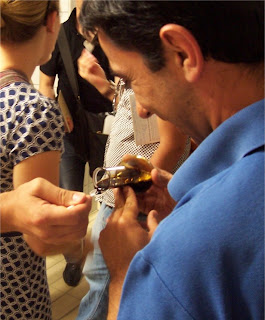
We learned about the rather lax standards for the substance known as Aceto Balsamico di Modena (“Modena Balsamic Vinegar”) – which require that it be of a minimum acidity of 6%, made from grape must (minimum 20%) and vinegar, caramel (maximum 2%, for colour and flavour), with a minimum 60 days aging. Ferrarini make a higher quality product which is aged a minimum of 8 to 10 years, but on the grocery shelf, consumers won’t understand the difference (other than price) when it’s ranked against the lower end products. This version is the balsamico you use for cooking and salad dressings. The more precious condiment is another story entirely.
What we may think we’re getting when we see the words balsamico and Modena and vinegar on a label is in fact correctly known as Tradizionale Balsamico, and there are two strains of it, one from Reggio-Emilia and one from Modena, made in more or less the same way but with a different balance of density and acidity, and bottled in different areas. They also have different quality standards: there are three quality levels for Tradizionale Balsamico di Reggio Emilia (red, silver and gold) and two for Tradizionale Balsamico di Modena. This is the highest end product, a thick, sticky goo that takes at least 12 years to make and should be doled out by the drop, as a condiment on strawberries or parmigiano-reggiano cheese, or even drunk from thimble-sized glasses after a meal or, according to Anna del Conte, diluted with ice and sweetened with a little sugar.
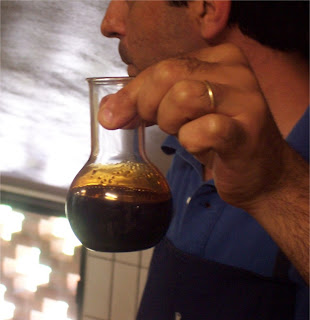
Before you get to that point, though, the stuff has to be made. According to tradition and regulation, it’s made only from grape must: local grapes are crushed and cooked until the volume has reduced by 50-60%, leaving a high density, sweet syrup. It’s fermented in barrels with only natural yeasts (present in air or the grapes themselves) for company. At the end of the year it will have reached about 6 or 7% alcohol, with lots and lots of residual sugars. A small quantity of older balsamico is added, containing live bacteria, and another two years or so go by while these bacteria carry out the acidification process which transforms the alcohol into acid.
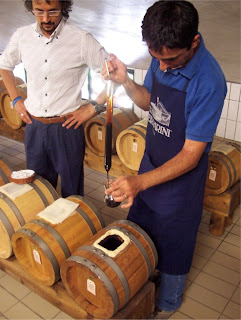
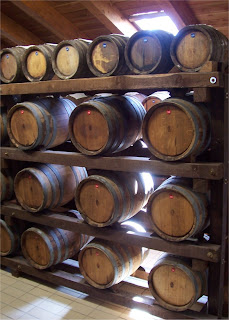
Then the real fun begins, when it’s decanted into a series of barrels of diminishing size, made of different woods: chestnut, oak, ash, mulberry, cherry and locust wood, which all add different flavours. There will be at least three but not more than ten casks, which are not sealed, the opening on the top covered with muslin to allow the liquid to thicken through evaporation. They are stored in vaults where the local climate can play its part: the cold winters concentrating the flavours, the hot summers evaporating the water content.
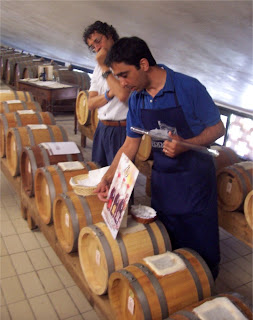
The barrels lose about a litre a year, so they are topped up in a formal process: the smallest barrel gets a litre from the next largest; that one gets two litres from its neighbour, and so on up the chain until the largest barrel receives about 30 to 40% newly acidified balsamico. This chain continues for between 12 and 25 years, at which point between 5-10% of the smallest barrel’s content is decanted and sent to the consortium for testing.
The consortium determines which of the three levels the balsamico will be sold as. These are related to age, but not completely determined by it, as the tasting is the final arbiter. The “lobster red” labelled balsamico is at least 12 years old; the silver is 12-25 years; and the gold is at least 25 years old.
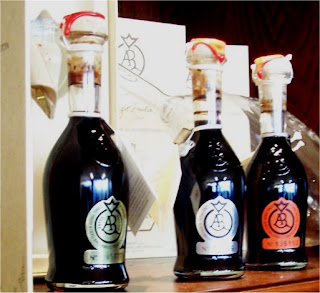
Because vinegar is a preservative, once you’ve invested your money (at least 30 euros for the red label, and upwards of 75 euros for the gold – in Italy; more if you buy it in other countries), you won’t ever have to worry about it going off (perhaps you’d like to pass a bottle down to your grandchildren?). It does behave much like honey though, and has a tendency to crystallise; but, like honey, it can be restored to liquid state by gently heating the bottle in water.
We got back to sticky Parma in time to rest up before supper. A group of us went to see chef Davide at Ristorante Mosaiko and ate ourselves into a happy stupour, with my favourites being an outstanding guinea fowl salad, dreamy gnocchetti topped with amazing mozzarella, and an even better than last time slice of bonet for dessert. I’m still digesting today…
-
Spain 7: markets, Barcelona, adios
Read Full Post: Spain 7: markets, Barcelona, adiosTwo were left behind with awful colds when we set off for Barcelona, and another was on her way to visit the hospital en route. But wait! While crossing the road to the train station I realised my hip had gone out, and rather than wait to see if it righted itself while doing a walking tour of the city markets, I turned tail and joined the fallen for a day of rest. The hip gradually recovered, and thanks to some strange fizzy Spanish anti-inflammatories, I was upright again by nightfall.
Lucky thing too, because Sunday was a free day, and we transferred to the excellently located Residencia Campus del Mar in Barcelona, where we were handed tickets for the Touristic Bus and set free until Monday morning. We took full advantage and circled the town in our yellow headphones, disembarking at the Miro museum an hour before it closed (early on a Sunday afternoon), so after a sprint round there we hopped back on and then wandered up the Rambla until we found somewhere to eat on a side street. Gazpacho, tortilla and paella did the job nicely and thus fortified we ploughed on to Sagrada Familia and Park Guell.
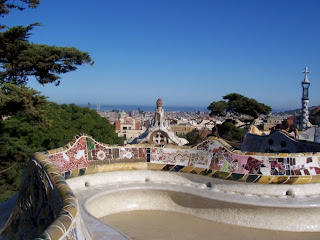
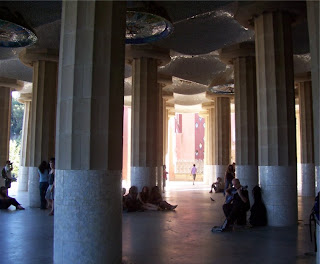
It was cooling off enough to dare riding the top of the bus, which we did until we reached Parc del Palau Reial de Pedralbes, where we made a tactical error by thinking we could sprint across the city to our hotel at Barceloneta faster by metro.
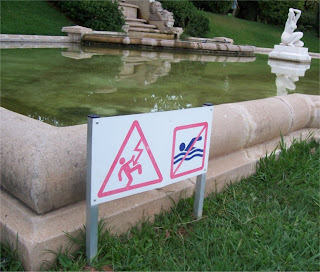
Not quite. It was so late that, nearly home, we stopped for a small but substandard Chinese meal before rousing the security guard – busy spraying flies in his office – and turning in for our last night in Spain.
We gathered at the bus in the morning, a couple of fallen comrades left to rest up, another taken to seek medical help for a mysterious swollen lip that appeared to be an allergic reaction. The rest of us had an excellent talk from communications and quality director Jordi Tolra about the markets of Barcelona, which number 46 (40 of them food markets) and which aim to allow the citizens to be within walking distance of at least one of them.
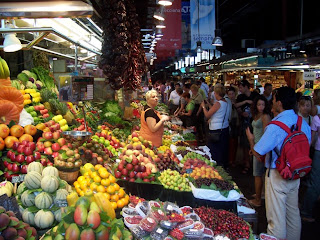
Would that other cities could follow this policy! Some of them had even made what seem to me unholy alliances with supermarkets – the one where we had our lecture, Santa Caterina (a former monastery which had been, before the monastery, an ancient food market), had a small supermarket within its walls. Tolra explained that the markets are gathered under one umbrella organisation, which is part of the city government, but that the stall-holders themselves are independent, but joined together by trade associations which organise them by food type. These associations, he said, are a long tradition in Catalonia, which was once an independent state with its own king and culture; after it was annexed by Spain, it kept its culture alive by creating Catalan associations, and trade assocations were the first of these.
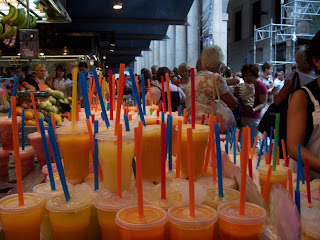
The markets have received a lot of money which is used for renovation and modernisation of the buildings, to bring them into line with contemporary needs (logistical, technological, environmental).
A few of us who’d missed the Saturday tour were taken round and shown the foundations of the monastery, the seniors’ housing next door, built at the same time as the refurbishment, and the loading areas where a couple of the market’s delivery vans were parked. Hearing that all the stall holders bought their produce at the same wholesale market disillusioned us a bit. There were, our guide said, a few stall holders who sold their own produce, but they were in the minority, and there were hardly any organic stalls either.

While carefully negotiating a hefty lunch from the organic tapas stand at the well thronged Boqueria market, I mulled over what we’d heard.
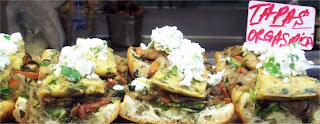
So if the food markets are buying their produce at the same place as supermarkets, where does the difference lie? I guess the sales are distributed to more and smaller sellers, who have less overhead and perhaps employ (en masse) more people with better expertise in their area. But Tolra was definite on the point that he wanted to drive traffic away from supermarkets and into the city markets: families that packed the kids into the car and drove to a supermarket for the day should be bringing them here instead. His vision of family entertainment was more wholesome than supermarket kiddieland, though: his programs aim to educate school children and offspring of visiting shoppers on food and nutrition, to counteract ‘hamburger culture’ and to bring kids into contact with food producers and sellers as well as teachers and nutritionists.
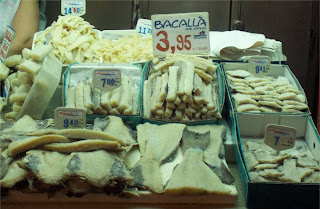
It’s an interesting and busy area, and the markets have some impressive communication programs going. How successful the markets of the future will be will depend on whether the political winds continue to blow kindly and generously in the direction Tolra hopes to keep sailing.


Latest Posts
- Writers at Word!
- Sublime and Twisted Readings coming up!
- Sublime
- Good weather for reading
- The world, the world
- Sublime launch!
Aldeburgh Poetry Festival Barny Haughton BBC BC poets Berkswell blackberries Black Stilt Bologna book launch Borough Market Carlo Petrini Catalonia Cyrus Todiwala dairy Daunt's Books Dijon Edinburgh Fanny Bay Feast of Fields Food and Morality food history food journalism Jenna Butler lardo Malahat Review Michael Pollan Okanagan olive oil tasting olive trees Omnivore's Dilemma Our Food Our Future Oxford Parmigiano-Reggiano Planet Earth Poetry poetry poetry readings Poetry videos prosciutto salumi Sean O'Brien Suffolk ticks Wendy Morton Wired Writing Yvonne Blomer
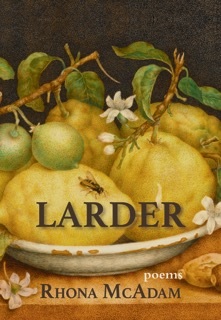
In her latest collection, Rhona McAdam navigates the dark places of human movement through the earth and the exquisite intricacies lingering in backyard gardens and farmlands populated by insects and pollinators, all the while returning to the body, to the tune of staccato beats and the newly discovered symmetries within the human heart.
“…A beautiful, filling collection, Larder is a set of poems to read at the change of the seasons, to appreciate alongside a good meal, and to remind yourself of the beauty in everything, even the things you may not appreciate before opening McAdam’s collection….”
Rhona McAdam is a writer, poet, editor, and Registered Holistic Nutritionist with a Master’s in Food Culture from Italy and a deep-rooted passion for ecology and urban agriculture. Her work spans corporate and technical writing to poetry and creative nonfiction, often exploring the vital links between what we eat and how we live. Based in Victoria, BC, and available via Zoom, Rhona is always open to new writing commissions, readings, or workshops on nutrition and the culinary arts.