Terra Madre opening

The first day of anything is chaotic, especially in Italy. The first day of a fair expecting 150,000 especially so. And the logistics of herding some 5000 very international delegates to the opening ceremonies for Terra Madre were handled with something less than military precision. But like all many-peopled events in this country, you can only stand back and admire the scope of the vision and the success of its achievements. That is, after you have tended your blisters, or picked yourself off the floor where hours ago you wept with fatigue and hunger, or exhausted your repertoire of bluster at the elegant shrugs and lengthy excuses of whatever group of officials you were dealing with. The queues are almost hilarious in their orderly beginnings and their scrum-like property when the gates open.

I especially enjoyed crossing three lines of traffic to get to the bus…

But then you taste the food, and see the pride in the faces of its makers, and you are suddenly enraptured; helpless in fact. Where else in the developed world can you still find so many labels that don’t yet all say “Made in China”? Food, shoes, clothing. You sense it’s a culture, like all of them, poised at the brink even so, but for now, we embrace it with gratitude.

Terra Madre opening ceremonies were all about indigenous. Spokespeople from many endangered cultures talked about the fight to preserve their traditions and languages.

The Sami reindeer herder pointed to the difficulties of maintaining a culture when your traditional territories have been appropriated by four different countries (Russia, Finland, Norway and Sweden), but invited the world to a conference on indigenous issues there next summer. Carlo Petrini was last up, of course, preaching fraternity and tolerance.

Lots of flags…

Generalised dancing and bopping about by the 161 flag-bearers at the end.

Comments Off on Terra Madre opening


Starting with Salone

What can one say about Salone del Gusto? The world’s largest artisanal food fair is how I describe it. We attempted to have a quick look round in an hour or so, but barely managed to tour one small corner. An interesting corner though.

We started in Sardinia, where there were lots of interesting shapes and sizes of cheese:

Sicily had lots and lots and lots and lots and lots of things on offer as well, including pastries and cheese.

The caciocavallo stall was nicely decorated:

They don’t hesitate to choose interesting ways to wrap their cheeses either:

The capers were incredible:

The salt was stupendous:

The plums were plump and perfect.

We passed France which had stunning cheeses of many shapes

The nougat was popular,

but the armagnac stand is going to be hard to pass by again. I feel sure my bags are going to be heavier by at least one bottle.

Comments Off on Starting with Salone


Italian beginnings

Flew into Bologna only yesterday, shattered after an early morning that could have passed for a late night; such are the travails of crossing London in time for a 7.10 flight from Stansted Airport. After a doze on the plane and another on the airport bus, I woke into a happy dream when we found our way to the market area.

After a good lunch at Tamburini, everything felt more than OK as we headed out of town, to start our journey west.

We arrived in Modena, which is Lambrusco country.

The meal at the Osteria Stallo del Pomodoro was affably served and began with this fetching amuse-bouche, a tart of soft goat cheese with pistachio and fried shredded beetroot. So pretty!

The antipasto misto was a marvellous misto of many interesting things. So colourful!

The Soffiato di Parmigiano-Reggiano was a cheesy mousse baked in a hollow pear and served with vino cotto. Very nice.

When in Modena… gelato with balsamico tradizionale. We behaved so nicely that the waiter gave us each a few precious drops of 25+ year old traditionale as a parting gift.

En route to Asti, we stopped for some inexplicable reason at the AutoGrill,

where the amusements are many. It is not what most countries stock their highway rest stops with…

On to Asti where the sun shone on our afternoon stroll.

A watchful dog:

Who wouldn’t want to shop at Save Money Square?

Supper at Il Convivio began with a warm and wonderful jerusalem artichoke tart, which was a sort of artichoke custard, with a sauce of local cheese and anchovies.

Then Ganascino di maiale – described as pork chicklets in the menu – braised in Barbera and beautifully seasoned; served on a polenta pancake which was a bit like a lovely dumpling.

When in Piemonte… of course it was necessary to finish with Bonet!

Tomorrow the biannual food and madness of Terra Madre/Salone del Gusto begins. Watch this space…

2 Comments


London: poetry and cheese

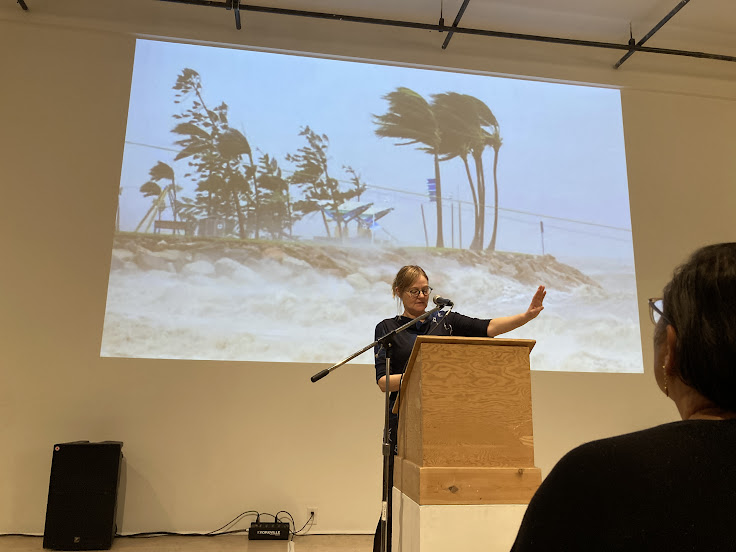
Back in London and what’s a food-loving poet to do but jump off the plane and onto the train and get myself to Islington to catch Poetry in the Crypt. Mike Bartholomew-Biggs

introduces the evening’s three featured readers and here are two of them; Franciscan monk, Murray Bodo, on his way home from Assisi to inner city Cincinnati

and the lovely Sue Rose whose first collection is due out next year from Cinnamon Press.

There were floor spots as well, including one from Peter Daniels:

After a wee drop with the poets at the Almeida‘s bar, I headed off into the night.

The next morning we had some breakfast at Gail’s Bakery, which offers an awesome brioche french toast with a decadent dollop of mascarpone

as well as a window full of breads and pastry, including some nice looking apricot-walnut bread.

After you’ve shopped there, you might want to stop for some cash, being careful not to be distracted.

We made our way to the South Bank Centre, crossing the Thames at Charing Cross on a beautiful autumn day

to check out the Cheese & Wine Festival that was enjoying big crowds on its last day. There was a lot to look at including some lovely breads to wrap your cheeses in

or if you prefer potatoes, you could get them smothered in raclette

and accompanied by French sausages

or a nice bowl of something hot.

There was British cheese

French cheese

and Italian.

There was a cheesemaking demonstration by organic cheeseman Bob Kitching, who taught young Thomas the bystander a thing or two about sampling a nice fresh Lancashire cheese.

4 Comments


Why I am not submitting anything to this anthology

While I think “companion animals” sounds like a lovely idea for an anthology, and I commend the Ontario Veterinary College for thinking to celebrate its anniversary by promoting literature on this theme, I must grind my axe on the conditions they’re imposing on contributors, ever so carefully, so as to split just a few familiar hairs.

I have some problems generally with anthologists who invite submissions for which they will offer no payment. A well-worn response by writers to this situation is to ask whether the printers will be paid? The people who make the paper the book is printed on? The truck drivers who transport the finished product? Then why not the creators without whose work the book does not exist? Though even so, being provided copies of the final collection is often enough to mollify me (3 copies in this case).

However. The guidelines for contributors to anthologies suggested in 2006 by the Writers Union of Canada are, I think, worth reviewing, even if they may be overly optimistic in today’s book publishing environment:

Royalties: “As a contributor to an anthology you can reasonably ask for a proportionate share of the authors’ usual royalty calculated on the list or selling price”

Fees: “A rule of thumb is $100 per page per edition in which the contribution will appear”

But to do as the editors of this anthology have done: offer no payment, and then stipulate firstly that the work cannot have been previously published, and secondly, that a reading fee must be paid… either condition is too much, and the two together are downright insulting.

Honestly, do we need the glory of being in print so badly that unpaid writers are willing to subsidize the publication of a collection that celebrates a well-paid profession? (Although perhaps if the publication credit came with a free veterinary visit, I could be persuaded this is a good deal for both sides.)

One question I have is just why the editors specify the submissions must be previously unpublished, and I suspect it may be that they fear copyright entanglements over material published in book form. Perhaps they are simply ignorant of the difference between books and journals, where the latter takes only first serial rights and leaves the author free to publish the work elsewhere.

But I strongly suspect they haven’t actually thought about it in relation to their own unwillingness to pay for the work. Being able to offer a poem, in my case, that has appeared in print for a nominal fee (literary magazines are, with luck, able to offer somewhere between $30 and $60 per poem in this country) takes some of the sting out of having an unpaid second appearance. And if this poem in a literary journal should have been previously read by its small and select readership, what harm does that do to an anthology later on? Particularly in this case, where the aim is not to garner literary creds: it’s a veterinary college, for heaven’s sake, and I’d guess the anthology is destined for the veterinary offices of the nation, not shrines of literature.

But even if the editors were to loosen their restrictions on previous publication, I would be reluctant to spend most of what I might have already earned from a poem in paying a reading fee (between $20-30 depending where you live) to submit it. (Though this fee does provide you with one copy of the anthology, even if you are not accepted for publication in it.)

As you may infer, this is not the first anthology I’ve encountered that puts harebrained restrictions on its contributors and then doesn’t even pay them. Where Canadian publishing is concerned, I’m afraid I continue to feel the pull of a downward spiral of water and a whiff of odure in its vortex.

2 Comments